Blog Details
- Home
- Blog Details
16
Dec
He's alive, pray for him": Zakir Hussain's nephew squashes death hoax Hussain's
manager, Nirmala Bachani, said that the artist had been suffering from high blood pressure. "We request all to wish him well and pray for him during this trying time," she said.
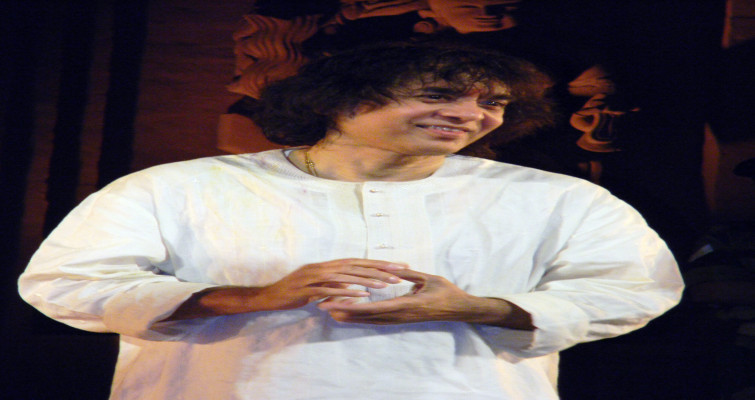
Reports of tabla maestro Zakir Hussain's death flooded social media on Sunday night, sending waves of condolence messages from politicians, celebrities, and fans around the world. However, these claims were quickly denied by his nephew, Ameer Aulia, who called for an end to the misinformation.
"My uncle Zakir Hussain is very much alive," Aulia wrote on an unverified X handle. "We request the media to stop uploading false reports. He is in serious condition, and we pray for his speedy recovery requesting all his fans across the world."
Harrison explained that instead of playing the sitar badly and offending his teacher Ravi Shankar, he had "transposed" what he'd learned onto his guitar. This would then allow him to do homage to Shankar's teaching on the Western instrument that he had mastered; and he encouraged Hussain to take what he had learned in California and make the tabla a world instrument.
Hussain set out to do exactly that and, in the process, became the poster child for cross-cultural musicianship.
But Hussain's own musical journey had begun many years before his arrival at 18 in the United States and long before his father, the legendary tabla player Alla Rakha, introduced him to the sounds of Miles Davis, Yusef Lateef, the Grateful Dead and The Doors among others.
In fact, Hussain's musical upbringing began when he was just two days old.
"My mother brought me back from the hospital after I was born and handed me to my father," he explains. "Now, according to tradition, my father was supposed to whisper prayers in my ear. [but] instead of saying prayers, he started reciting rhythm riffs and patterns.".My mother, of course, was furious and said, 'What in the world are you doing? You are supposed to say a prayer.' And he said to her, 'That is my prayer.This is how I pray, and this is how he will pray.'" For the first few months, Hussain's father held him in his arms for an hour and a half every day, singing into his ear and the "hard drive" of his brain. Then, when Hussain was five or six, this teaching evolved into a kind of rejoinder, with father and son exchanging rhythms like a language in which they formed sentences, paragraphs and finally a whole story. That kind of thinking is, I guess, at the core of being able to improvise," says Hussain. This helped him when, aged only seven, he found himself filling in for his father alongside Ali Akbar Khan, Ravi Shankar's brother-in-law and arguably the "greatest Indian instrumentalist" of all time. "There I was sitting behind my father," Hussain recounts, "and the concert was proceeding into its fourth hour. Suddenly, he had to go to the loo, and he said, 'You take over.' That was a trial by fire, but it worked."
Another seminal moment occurred when his father surprised him one evening by taking him to a concert.
"We were a bit late owing to the traffic and just as we were walking in, this intoxicating piano riff came my way. And then, bang, I was hit with the incredible sound of a big band. It was the great Duke Ellington live in Bombay! I was eight years old, and I was hooked."
In his mid-teens, Hussain responded to the call of Bollywood, where he established himself as the "rhythm guy" and relished "the spontaneous jam sessions during the lull in recordings".
"My mind was already opening up to so many different musical possibilities which, of course, were magnified after arriving in America."
Having grown up listening to many of the greatest acts of the 20th century, coming face to face with them proved eye-opening for the young tabla player.
He recalls on one occasion in 1970 being offered what he took to be a whisky by a rock star at the London home of classical guitarist and lutenist Julian Bream. It was, in fact, apple juice; the man who offered it to him was Mick Jagger.
The way names like Jagger's just roll off Hussain's tongue belies the reverence he holds for his impressive circle of friends and colleagues, and the music they make together.
True to his father's word, Hussain acknowledges that performing is an act of prayer.
“It’s my meditation, but it’s not an imposition on the audience,” he says. “I’m not asking them to pray; I’m not asking them to close their eyes and meditate.”
Hussain says it’s something he and his fellow musicians, Hindustani violinist Kala Ramnath and Carnatic veena player Jayanthi Kumaresh, feel on stage during Triveni, which they will be performing in Melbourne and Sydney this July.
Named after the mythical site where three of India's sacred rivers meet, Triveni was first performed by the trio while touring the US in 2022. "Kala Ramnath and Jayanthi Kumaresh are two of the finest exponents of the art that they represent, and it is an immense pleasure to be able to sit on the stage with them," Hussain says.
"We have an idea of going from point A to B to C to D, but how we get there is open to conversation. We are not playing the same ragas or the same rhythm cycles every day; we don't want to fall into a situation whereby we play the same set over and over again. That does not lend itself well to improvising."
Hussain continues to say, "We wish that when we begin performing and the audience is with us, there may be an instance or two of magic; an instance when spirits are united, when confluence of all the things in the hall happens so that we rise to an altogether different level of understanding to a revelation that heightens the joy, happiness, and unified ecstasy.